A client books, the slot fills up on your calendar, and then... nothing. They don't show, they don't call, and you're left looking at an empty chair you can never sell twice. It feels like a minor annoyance. It almost never is.
The empty slot is just the visible tip of the cost. Underneath it sits wasted wages, wasted prep, marketing spend you'll never recover, and a client you turned away because the calendar looked full. Add it all up and the real number is far bigger than most owners realise.
This guide breaks down exactly what missed appointments cost — direct and hidden — gives you a simple formula to calculate your own yearly figure, and shows how even a small reduction pays for itself many times over.
The best way to reduce missed appointments is to design the whole booking flow deliberately. Our complete online booking setup guide shows how reminders, forms, policies and booking links fit together.
The direct cost: lost revenue
Start with the obvious part. When someone doesn't turn up, you lose the value of that appointment outright. There's no inventory to resell, no second chance — that block of time is simply gone.
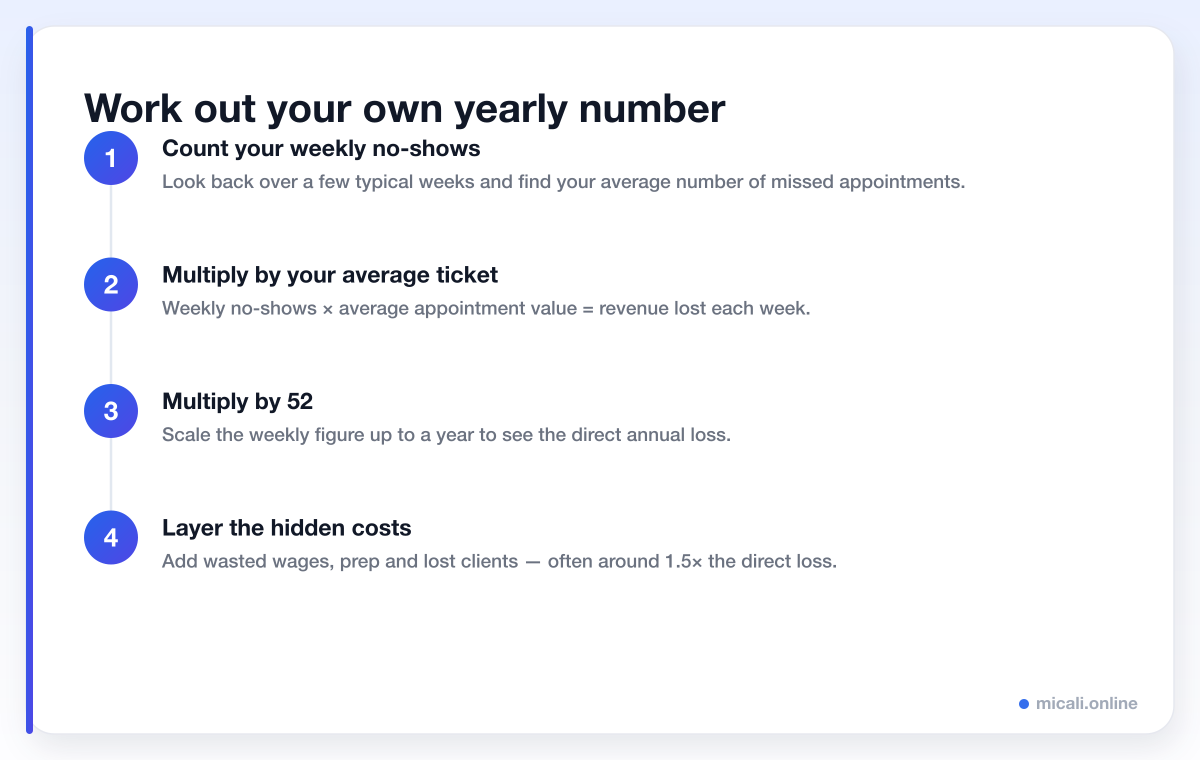
The maths is brutally simple, and that's what makes it sting. Here's the core formula:
Weekly no-shows × average ticket × 52 = yearly lost revenue.
If your average appointment is worth €45 and you lose just five a week, that's €225 a week — or €11,700 a year walking straight out the door. That's a holiday, a part-time hire, or a serious chunk of your annual profit, gone before you've counted a single hidden cost.
The figure scales with your prices. A dental clinic losing four €90 appointments a week is already past €18,000 a year. A tutor losing two €30 sessions is closer to €3,000. Whatever your numbers, the formula gives you a concrete annual figure to work with — and it's almost always larger than the gut-feel estimate.
The hidden costs nobody adds up
Lost revenue is the headline, but it's rarely the whole story. The most expensive part of a no-show is the part that doesn't show up on any invoice. Here's what hides beneath the surface.
Wasted staff time and wages
Your stylist, therapist or trainer was scheduled, paid and ready. When the client doesn't arrive, you're paying a wage for an hour that earns nothing. If staff are on commission they lose out too — which quietly chips away at morale and retention.
Wasted prep and product
Many appointments cost you something before the client even walks in. A room set up, colour mixed, equipment prepped, a treatment couch turned over. When the booking evaporates, so does that prep — and any perishable product mixed for it goes in the bin.
The turned-away client
This is the sneaky one. While that slot sat "booked", someone else wanted it, saw a full calendar, and went elsewhere. You lost the no-show and the customer who would happily have taken their place. One empty slot, two lost bookings.
Wasted marketing spend
It costs money to win a customer — ads, offers, referral incentives, your time. When a hard-won client no-shows, the acquisition cost you paid to get them in the diary is simply burned. You paid to fill a seat that ended up empty.
Morale and momentum
A diary full of gaps is demoralising. Staff lose rhythm, the day feels disjointed, and a run of no-shows can sour the whole team's mood. It's hard to put a euro figure on it, but anyone who's run a service business knows it's real.

Stack these together and the true cost of a no-show often lands at roughly 1.5 times the lost revenue alone. So that €11,700 of direct losses can quietly become closer to €25,000 a year once the hidden costs are counted. (These multipliers are illustrative — your own mix will depend on wages, prep and how busy you are.)
A no-show isn't one lost appointment. It's the lost appointment, plus the wage you paid anyway, plus the prep in the bin, plus the client you turned away — and the marketing spend that brought in someone who never arrived.
What it looks like across different businesses
The cost of missed appointments varies enormously by your price point and how many you lose. A handful of low-value no-shows is annoying; a handful of high-value ones is a genuine threat to the business. The table below shows illustrative yearly losses for a few common business types — direct revenue only, before hidden costs.
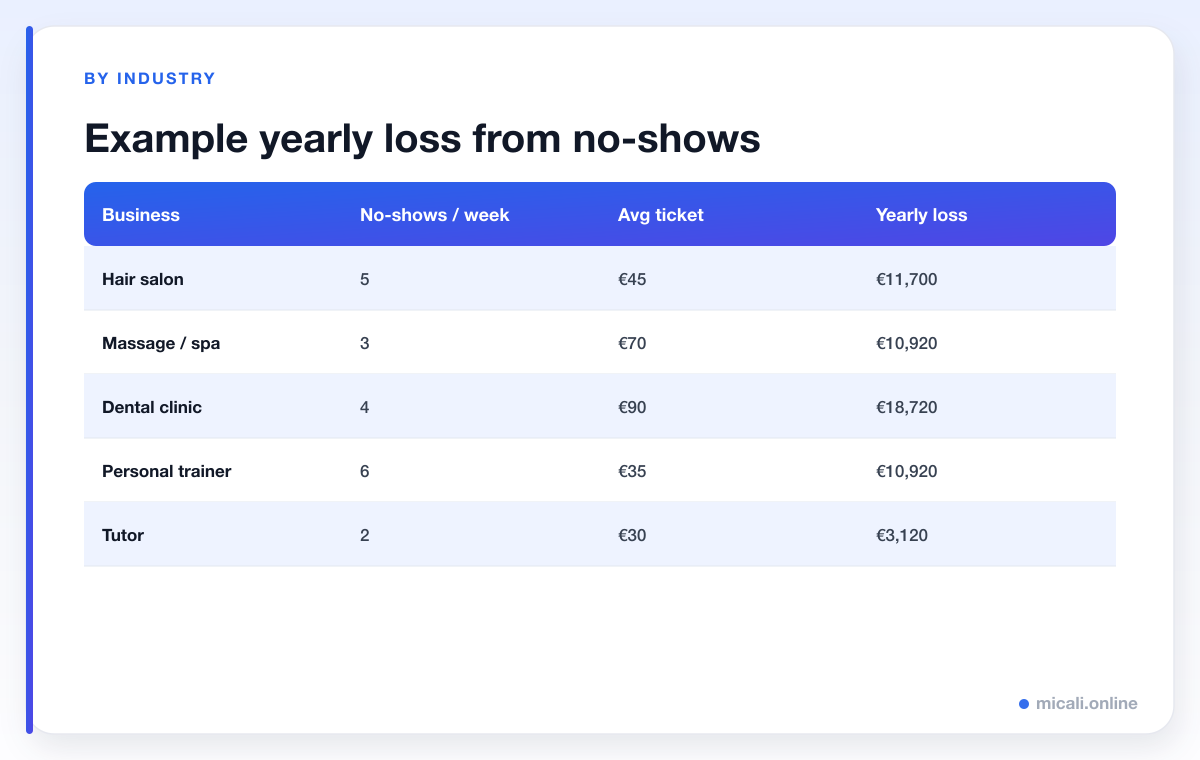
Two things jump out. First, even a "small" no-show problem adds up to four or five figures a year. Second, the higher your average ticket, the more each individual no-show hurts — which is exactly why higher-value businesses tend to be quickest to introduce deposits. For a deeper look at the underlying causes, see our guides on customer management.
Why even a small reduction pays for itself
Here's the encouraging flip side. Because the costs compound, so do the savings. You don't need to eliminate no-shows to see a real return — you just need to nudge the number down.
Take the salon losing €11,700 a year in direct revenue. Cut no-shows by just a third — a realistic result from simply turning on reminders — and you claw back around €3,900 a year in revenue alone. Add the hidden costs you also avoid, and the true gain is closer to €6,000–€9,000.
Now weigh that against the cost of fixing it. Automated reminders and a booking system can be free to start with. A small deposit costs you nothing at all. The return on a few hours of setup is enormous — this is about as close to free money as a service business gets.
You don't have to reach zero no-shows. Shaving even a third off the rate typically pays back the cost of fixing it many times over within the first year.
How to bring the cost down
The good news is that no-shows are highly predictable, which makes them highly preventable. A few simple changes target the biggest causes at once. For the full playbook, see our guides on reducing no-shows — but here are the highest-impact moves.
- Automated reminders. The single highest-return change. Most no-shows are simply forgotten appointments. An email plus SMS reminder 24 hours and a couple of hours before closes that gap for a fraction of what one no-show costs.
- Deposits or card on file. A small upfront commitment changes the booking from "maybe" to "committed", and gives you a fair way to cover your costs if someone vanishes.
- A waiting list. When a slot does free up, an automatic waiting list backfills it with the next client in line — turning a costly gap into a recovered booking.
- One-tap rescheduling. Many no-shows are really failed reschedules. Make moving an appointment effortless and you'll convert would-be no-shows into a simple time change.
- A clear cancellation policy. Setting expectations up front, and repeating them in reminders, encourages people to give you notice instead of just vanishing.
Each of these costs a tiny fraction of the losses it prevents. Together, they can move a 15% no-show rate down towards the low single digits.
How micali.online helps you cut the cost
micali.online is built to do this heavy lifting for you. Automated email and SMS reminders, instant confirmations, one-tap rescheduling, deposits and card-on-file, and a built-in waiting list are all part of the platform — every lever in this guide, on autopilot.
You can set up a free booking page in minutes, with no credit card required, and start protecting your calendar the same day.
Frequently asked questions
How do I calculate the cost of my no-shows?
Use the core formula: weekly no-shows × your average appointment value × 52 = direct yearly lost revenue. Then add roughly half again to account for hidden costs like wasted wages, prep and turned-away clients to get a fuller picture.
Are missed appointments really that expensive?
For most service businesses, yes. Even a handful a week typically adds up to four or five figures a year in direct revenue, and the hidden costs can push the true figure half as high again. It's one of the largest avoidable costs a small business carries.
What are the hidden costs of a no-show?
Beyond lost revenue: the wages you paid staff for an empty slot, prep and product wasted, the marketing spend that won a client who never arrived, the customer you turned away because the calendar looked full, and the hit to team morale.
What's the cheapest way to reduce the cost?
Automated reminders. They address the most common cause of no-shows — forgetting — at a tiny cost, and on micali.online you can turn them on for free. Pair them with a small deposit for high-value appointments to push the number down further.
The bottom line
A missed appointment is never just an empty slot. It's lost revenue, wasted wages, binned prep, a turned-away client and burned marketing spend — and across a year those costs quietly stack into thousands. Run your own numbers with the formula above, and the case for fixing them becomes obvious.
The best part: you don't need to reach zero. A modest reduction pays back the effort many times over, often in the first month.
Ready to stop missed appointments draining your business? Create your free micali.online booking page and start sending automated reminders today.