
Every salon owner knows the sinking feeling: a last-minute cancellation, or a client who simply doesn't turn up. The chair sits empty, the stylist stands idle, and the income for that slot is gone for good. A clear cancellation policy is your best defence — and writing one is easier than you think.
A good policy does three things at once. It protects your time and income, it sets fair expectations so clients aren't surprised, and it does so in a tone that keeps people feeling welcome rather than told off. The trick is being kind and firm at the same time.
This guide covers why you need a policy, exactly what to put in it, and how to word it. Then you get 12 copy-paste example policies you can adapt in minutes — from gentle to strict, plus deposit, late-arrival and group-booking versions.
A cancellation policy works best when it appears inside a clear booking flow. For the full setup, see our complete online booking setup guide.
Why your salon needs a cancellation policy
Without a policy, every cancellation is a judgement call, and clients have no idea where the line is. With one, the expectation is set the moment they book. People genuinely respect boundaries they know about in advance — what frustrates them is being charged for a rule they never saw.
A written policy also protects you in the rare awkward conversation. When a fee is published up front, applied consistently and easy to point to, it stops being personal. It's simply "the policy", and that makes it far easier to enforce calmly.
A cancellation policy isn't about punishing clients. It's about respecting everyone's time — yours, your team's, and the client on the waiting list who would have loved that slot.
What to include in a salon cancellation policy
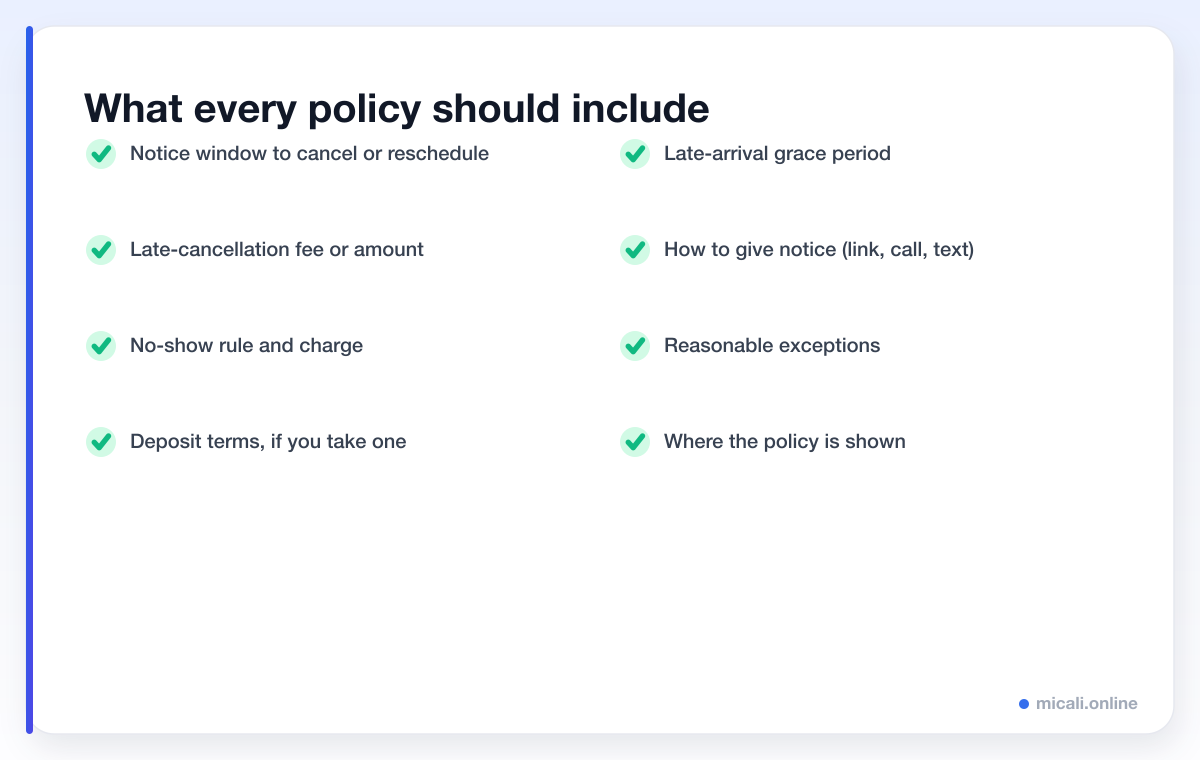
A strong policy is short but complete. These are the building blocks every good one shares — pick the parts that fit your salon and leave the rest.
1. A clear notice window
This is the heart of the policy: how much warning you need to cancel or reschedule without a charge. Common windows are 24 or 48 hours. Pick one that matches how quickly you can refill a slot, and state it in plain numbers rather than vague phrases like "reasonable notice".
2. A late-cancellation fee or deposit
Decide what happens when someone cancels inside the notice window. Options range from no fee at all, through a fixed amount or a percentage of the service price, to a non-refundable deposit taken at booking. Whatever you choose, write the actual figure so there are no surprises.
3. A no-show rule
A no-show — booking and never arriving — usually carries the strongest charge, because it gives you no chance to refill the slot. Many salons charge a higher percentage, or the full service price, for a no-show than for a late cancellation.
4. A late-arrival rule
Clients arriving late eat into the next appointment. A short grace period (say 10–15 minutes), after which you may need to shorten or rebook the service, keeps your day running on time and feels fair to everyone waiting.
5. How to give notice
Make cancelling or rescheduling effortless. A one-tap link in the confirmation and reminder is ideal — the easier it is to reschedule, the fewer silent no-shows you get. List every channel you accept: online link, phone, or text.
6. Reasonable exceptions
Life happens. A line acknowledging genuine emergencies — illness, family crises — shows you're human and gives you room to waive a fee at your discretion without rewriting the rule.
How to word it kindly but firmly
Tone is everything. The same rule can read as a warm request or an angry threat depending on the words you choose. Lead with the why, use "please", and keep it brief. Save the all-caps and the long list of penalties — they make clients defensive before they've even booked.
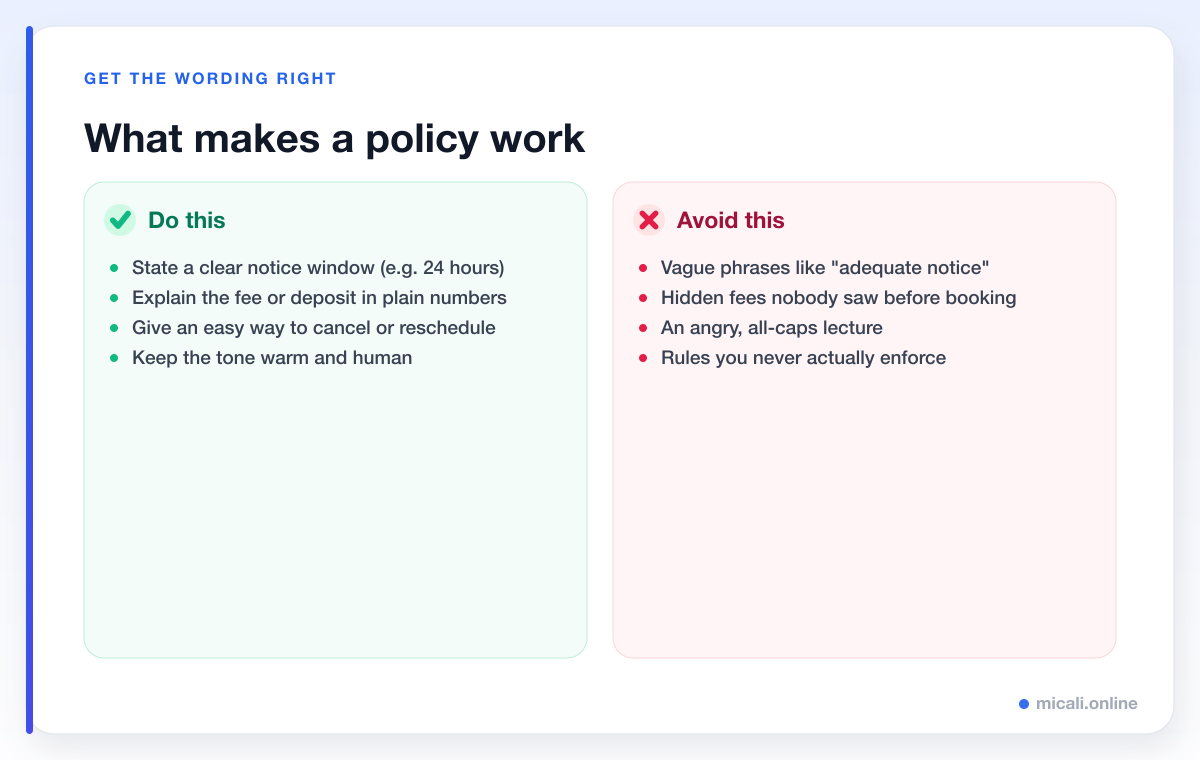
Notice the difference: the good version explains the window, the fee and how to give notice in plain language, and stays human throughout. The poor version hides the cost, sounds aggressive, and uses vague terms that lead to arguments later. A policy you'd feel comfortable reading aloud to a regular is usually the right one.
Where to show your cancellation policy
The best-worded policy is useless if nobody sees it. Repeat it at every step so there's no "I didn't know":
- On your booking page, visible before the client confirms.
- In the booking confirmation email or text they receive instantly.
- In appointment reminders, with a one-tap reschedule link.
- On display in the salon and on your social profiles.
For more ways to keep your calendar full, see our customer management guides.
Choosing your policy style
There's no single "correct" policy — the right one depends on how busy you are, how easily you fill cancellations, and your clientele. Most salons land in one of four styles.
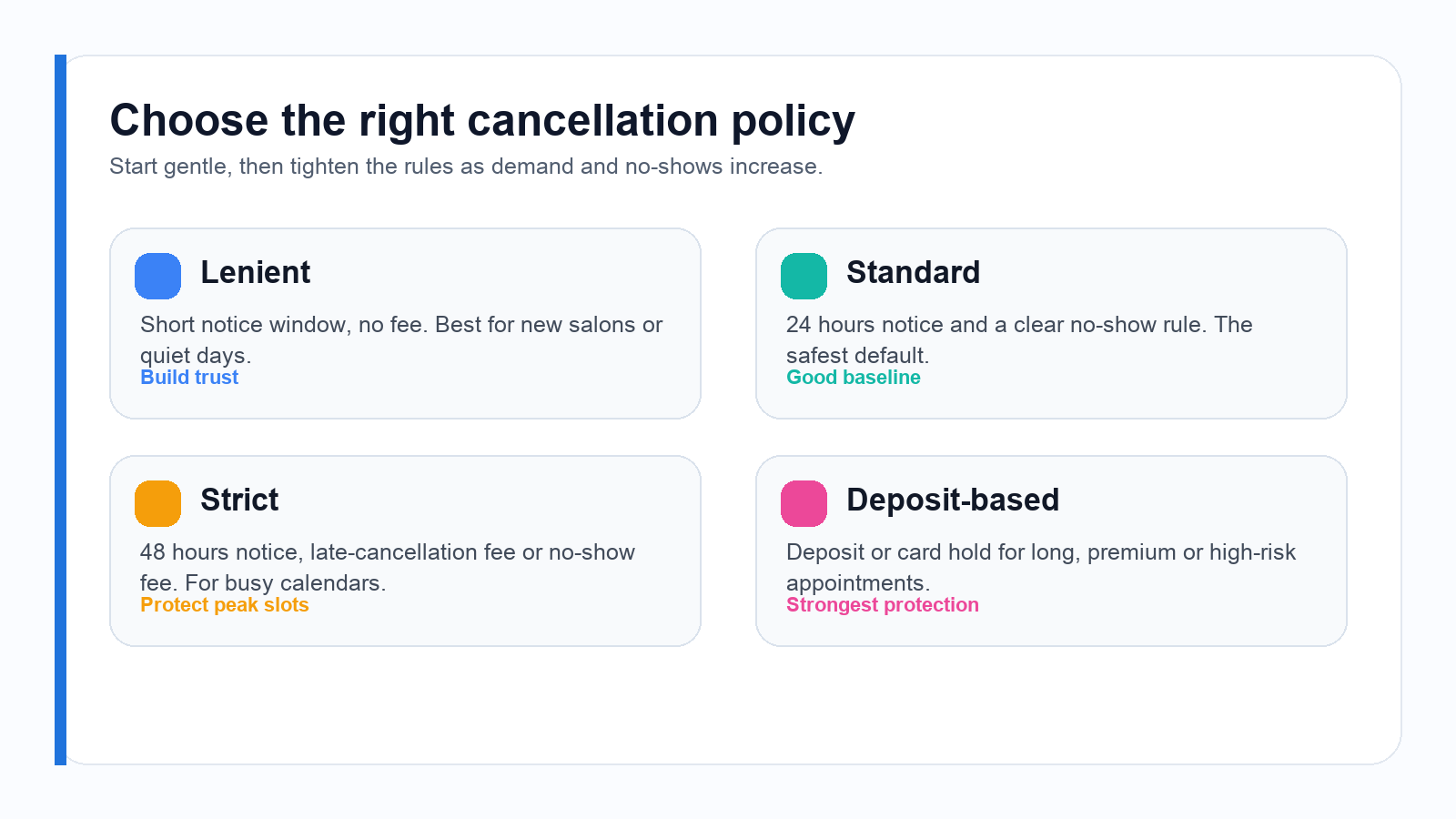
If you're new or building trust, start lenient and tighten up as you get busier. Established salons with long waiting lists can justify a stricter stance. Deposits give the strongest protection of all and are increasingly normal, especially for longer or higher-value services.
12 salon cancellation policy examples to copy
Below are 12 ready-made policies. Swap in your salon name, hours and fees, then paste them onto your booking page and into your confirmations. They run from the most relaxed to the most protective, followed by specialised versions for specific situations.
Lenient policies
Friendly and forgiving — ideal for new salons, quieter days, or building loyalty without scaring people off.
1. We completely understand that plans change. If you need to cancel or reschedule, just let us know as soon as you can so we can offer your slot to someone else. There's no charge — we simply appreciate the heads-up.
2. Please give us at least 12 hours' notice if you can't make your appointment, so we can fill the gap. We don't charge cancellation fees, but repeated no-shows may mean we ask for a small deposit on future bookings.
3. Need to change your appointment? No problem at all. Use the reschedule link in your confirmation, or give us a call. We only ask that you don't leave us with an empty chair and no notice — a quick message is all it takes.
Standard policies
The popular middle ground: a clear 24-hour window with a modest fee. Fair to clients, protective of your time.
4. We kindly ask for 24 hours' notice to cancel or reschedule. Cancellations within 24 hours of your appointment are subject to a fee of 50% of the booked service. No-shows will be charged the full service price. To cancel, just tap the link in your confirmation or call us.
5. Your appointment time is reserved just for you. Please give us at least 24 hours' notice to cancel or move your booking. Late cancellations are charged a flat £20, and missed appointments are charged in full. We'll always try to be flexible in a genuine emergency.
6. To respect everyone's time, we ask for 24 hours' notice for any change. Cancel in time and there's no charge. Cancel late, and a 50% fee applies; for a no-show, the full amount is due. Please reschedule using the link in your reminder so we can offer the slot to another client.
Strict policies
For busy salons with long waiting lists, where a late cancellation almost always means a lost slot.
7. Because our appointments book up well in advance, we require 48 hours' notice to cancel or reschedule. Cancellations inside 48 hours are charged 50% of the service, and no-shows are charged 100%. A card on file is required to confirm your booking.
8. Your stylist's time is reserved exclusively for you. Less than 48 hours' notice incurs a 50% charge; less than 24 hours or a no-show incurs the full service price. We hold these standards so we can keep offering same-week availability to everyone.
Deposit-based policies
The strongest protection. A deposit or card is taken at booking, then applied to the final bill — or kept if the client cancels late or fails to show.
9. A non-refundable deposit of £20 is required to secure your appointment and is deducted from your final bill. The deposit is fully transferable if you reschedule with at least 24 hours' notice. It is forfeited for late cancellations and no-shows.
10. To book, we take a card on file. You won't be charged anything now — your deposit simply holds the slot and comes off your total on the day. A late-cancellation or no-show fee of 50% may be applied to the card, with 24 hours' notice always given fee-free.
Late-arrival, group and peak-time policies
Niche versions for specific situations. Add them alongside your main policy where relevant.
11. Late arrivals: we'll always do our best to accommodate you, but if you arrive more than 15 minutes late we may need to shorten your service to protect the next client's time, or rebook you. The full service price still applies.
12. Group & peak-time bookings: parties of three or more, and bookings on our busiest days, require a deposit and 72 hours' notice to cancel or reduce numbers. Cancellations inside this window are charged 50% per person, as these slots are in high demand and hard to refill.
A quick word on fairness
This isn't legal advice, but a few principles keep any policy on the right side of fair. Make sure clients can clearly see and agree to the policy before they book, keep your fees proportionate to the service rather than punitive, and apply the rules consistently so no one feels singled out. If you take card details or deposits, be transparent about exactly when and how a charge might happen. If you're ever unsure about local consumer rules, check with a qualified adviser in your area.
Frequently asked questions
How much notice should a salon ask for?
Most salons ask for 24 hours, which gives enough time to offer the slot to someone else. Busier salons with waiting lists often move to 48 hours. Match the window to how quickly you can realistically refill an opening.
Is it normal for salons to charge a cancellation fee?
Yes — it's increasingly standard, particularly for longer or higher-value services. The key is to communicate the fee clearly up front and apply it consistently, so it reads as fair rather than a nasty surprise.
Should I take a deposit?
Deposits offer the strongest protection against no-shows and late cancellations, and clients are now well used to them. They work especially well for new clients, expensive treatments and your busiest times. A deposit that comes off the final bill feels fair to almost everyone.
How do I enforce a cancellation fee without losing the client?
Lead with empathy, refer to the published policy rather than making it personal, and offer to apply the fee to a future booking where it makes sense. Most people accept a fee gracefully when they were told about it in advance and you're consistent.
Where's the best place to display my policy?
Everywhere a client books or is reminded: your booking page, the instant confirmation, every reminder, and on display in the salon. The more often people see it, the less friction there is if you ever need to apply it.
Make your policy work automatically
A great policy only pays off if it's seen and applied every time — and that's where the right tools help. With micali.online you can show your cancellation policy on your free booking page, repeat it in instant confirmations and automated email and SMS reminders, add one-tap rescheduling, and take deposits or hold a card on file — so your policy enforces itself without any awkward conversations.
Ready to put it on autopilot? Create your free micali.online booking page, paste in one of the templates above, and start protecting your calendar today.